
SIRIUS DOG SLEDGE PATROL
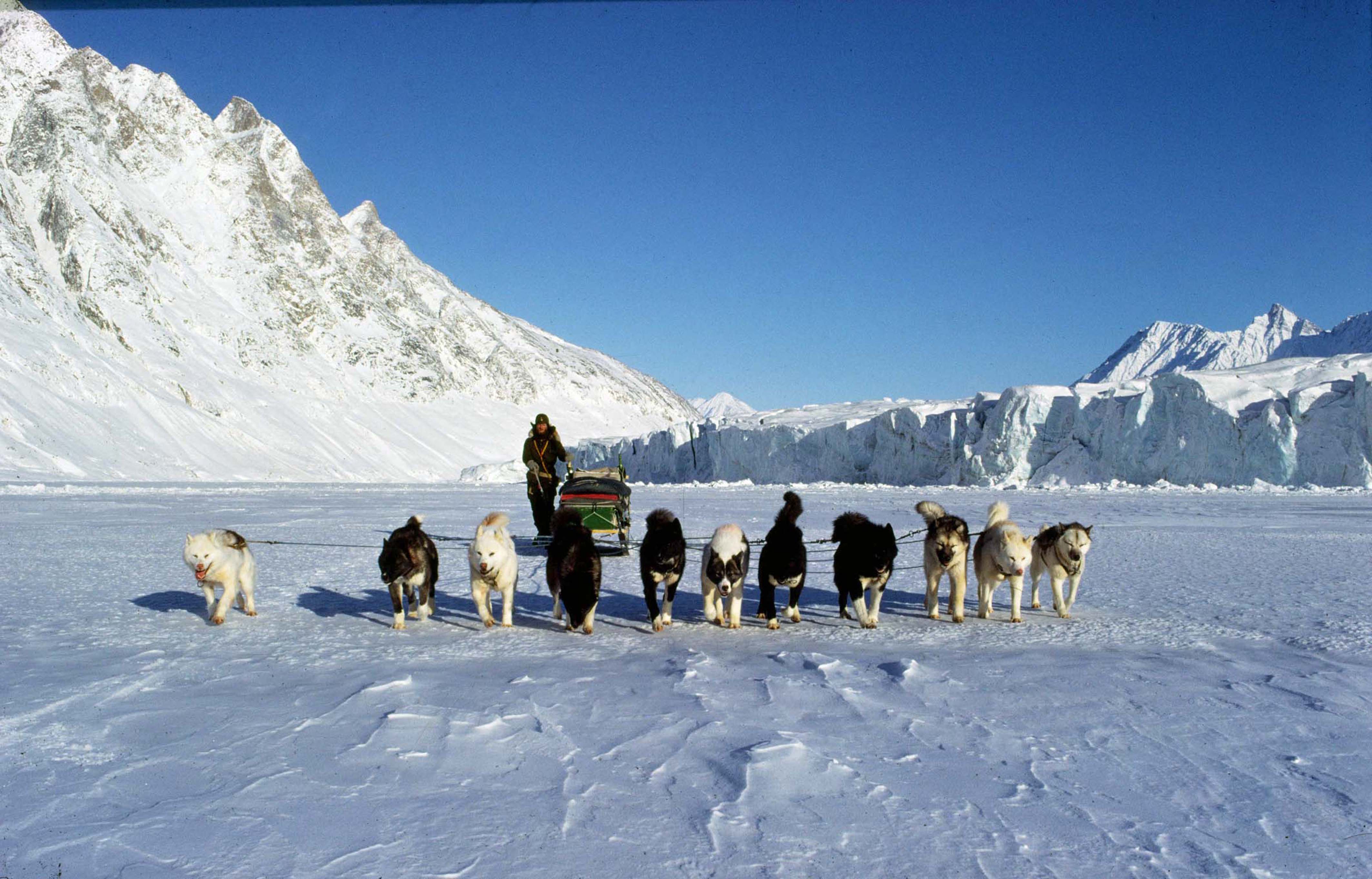
The military Sirius sledge patrol enforces the sovereignty of the Kingdom of Denmark over North and North-East Greenland. 15,000 - 20,000 km are covered by dog sledge patrolling annually. Since 1950, the sledge patrol has traveled more than 1 million kilometers by dog sledge along the uninhabited coasts of North and Northeast Greenland.
After the end of World War II, the escalation of the "Cold War" soon led to a desire for improved, systematized surveillance of North and Northeast Greenland. The Danish Navy, which is responsible for surveillance of Greenland, recommended the establishment of a military sledge patrol. The Danish government agreed to the proposal, and in 1950, a sledge patrol was established in the utmost secrecy - under the auspices of the Navy - under the name Operation Resolut. The patrol was born on August 18, 1950. That was the day the crew first gathered on Ella Ø - the patrol's base for the first year.
In the summer of 1951, the patrol moved to Daneborg, where a new headquarters, "Sirius Daneborg", was built. At the same time, the name was changed to Slædepatruljen Resolut. In 1953, the patrol changed its name again. The reason was that there is a weather station in Northern Canada called "Resolute Bay" and to prevent misunderstandings, the name was taken after Sirius - the brightest star in the constellation Alpha Canis Majoris (the Dog Star). It was under this name that the sledge patrol gradually became known to the public.
The Sirius sledge patrol is tasked with enforcing sovereignty and monitoring the uninhabited coast between Liverpool Land on the east coast of Greenland and Nares Strait on the northwest coast, a stretch of coastline of approximately 2,100 km - as the crow fly. Patrolling is carried out by dog sledge in the winter months, from approximately 1 November to 1 June, and in the summer by sailing the ice-free fjords. In addition to military surveillance and enforcing sovereignty, the patrol has also had civil police authority in the area since 1950 and constitutes the basic, critical infrastructure in the area. Within the framework of the national park, the patrol officers supervise the many research and sports expeditions and cruise ships during the summer.
Sirius, which was previously operationally coordinated directly from Denmark under the Defence Command in Vedbæk, was placed under the Greenland Command (GLK) in 2006, and when this was merged with the Faroe Islands Command to form the Joint Arctic Command (JACO) in 2012, Sirius moved with it. JACO, which has its headquarters in Nuuk, is responsible for the operational management of the patrol, while the training and supply part is handled by the Station and Patrol Service Greenland (SPG) located at Aalborg Air Station.
The crew, which was increased from 10 to 12 men in 1951, previously consisted exclusively of officers and warrant officers from the three armed forces who had volunteered for the service. Today, the service is still voluntary; but instead the requirement is that one has completed basic training in the Armed Forces or in the Emergency Management Agency. In addition to the basic health requirements of the Armed Forces, one must also be able to meet the special health requirements of the training. In addition, one must have a clean criminal record and be able to pass security clearance and - not least - have a cleared home situation in order to be able to complete the full deployment; i.e. 26 months nonstop in Northeast Greenland.
Prior to admission to Sirius, the aspirants must prove themselves suitable through a nine-month training course under SPG, including one month of winter training at the Armed Forces Guard Mestersvig. This is followed by the final selection and departure to Northeast Greenland. A sledge team, i.e. two men and 12-14 dogs, can be on a continuous sledge journey for up to 4-5 months, during which they meet other people only very few times. In light of the criticism that followed the Hague ruling in Denmark's favor, that Denmark may have shown will but not results, it is worth mentioning that since 1950 Sirius has drawn over 1,000,000 km of sledge tracks along the uninhabited coasts of North and Northeast Greenland.
The Sirius sledge patrol is one of the three special forces of the Danish Armed Forces. The other two are the Jægerkorpset (the Huntsmen Corps) and the Frømandskorpset (the Navy Seals Corps). The three elite forces are different, but all require exceptional physical and mental strength. Links to more information about Sirius and Northeast Greenland.